




Introduction
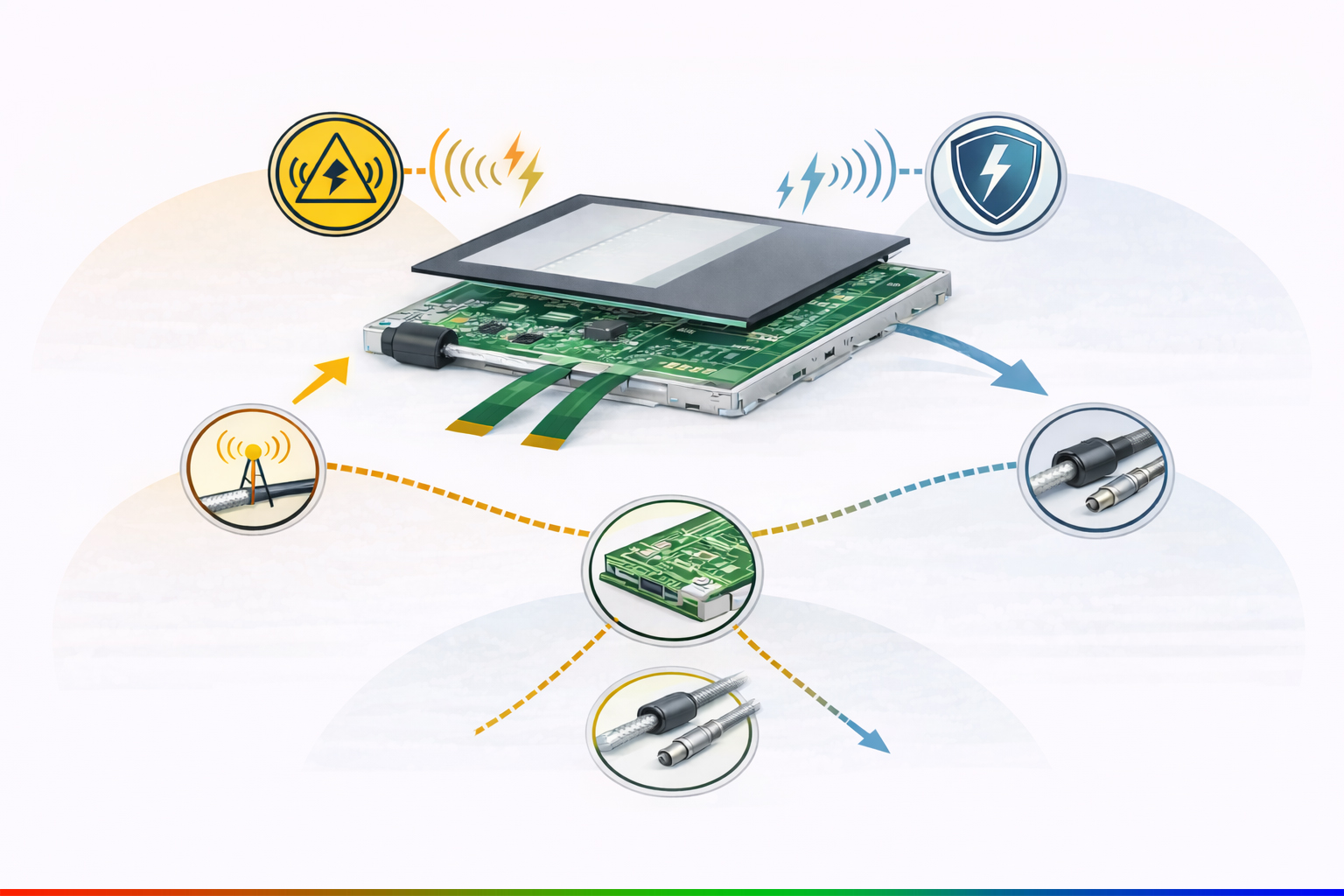
Electromagnetic compatibility (EMC) of displays is a crucial factor for the reliable operation of electronic systems – particularly in applications such as automotive engineering, medical technology, industrial electronics and aviation. Displays not only act as receivers of electromagnetic interference (EMI), but also as potential sources of interference. A lack of EMC measures can lead to malfunctions, data loss or total failure.
Typical problems
Typical EMC problems with displays:
- Interference emissions
LCD, OLED and TFT displays, particularly those with a CTP, generate high-frequency signals via signal lines or the touch controller. - Immunity
Displays are sensitive to interference from the environment, e.g. RF sources, power supplies, mobile communications or other electronic components. - Coupling
Interference can easily be coupled in or radiated via cables or inadequately shielded enclosures.
Influencing factors
Several factors can affect EMC performance:
- PCB layout
Poor grounding, long signal lines or missing impedance matching - Cables and connectors
Unshielded or poorly assembled cables can act as antennas - Touch technology
Capacitive touch sensors require sensitive analogue front-ends and are therefore particularly susceptible to interference
(Guard/sens cables – consult a technician for further details)
Optimisation measures
Several measures can be taken to optimise EMC:
- Shielding
Shielded cables, ferrites, conductive foils or metal enclosures can help - Filtering
RC/LC filters, ESD protection components and EMC protection diodes at inputs and outputs - Layout optimisation
Shorter signal paths, continuous ground planes and differential signal routing
Introduction
Electromagnetic compatibility (EMC) of displays is a crucial factor for the reliable operation of electronic systems – particularly in applications such as automotive engineering, medical technology, industrial electronics and aviation. Displays not only act as receivers of electromagnetic interference (EMI), but also as potential sources of interference. A lack of EMC measures can lead to malfunctions, data loss or total failure.
Typical problems
Typical EMC problems with displays:
- Interference emissions
LCD, OLED and TFT displays, particularly those with a CTP, generate high-frequency signals via signal lines or the touch controller. - Immunity
Displays are sensitive to interference from the environment, e.g. RF sources, power supplies, mobile communications or other electronic components. - Coupling
Interference can easily be coupled in or radiated via cables or inadequately shielded enclosures.
Influencing factors
Several factors can affect EMC performance:
- PCB layout
Poor grounding, long signal lines or missing impedance matching - Cables and connectors
Unshielded or poorly assembled cables can act as antennas - Touch technology
Capacitive touch sensors require sensitive analogue front-ends and are therefore particularly susceptible to interference
(Guard/sens cables – consult a technician for further details)
Optimisation measures
Several measures can be taken to optimise EMC:
- Shielding
Shielded cables, ferrites, conductive foils or metal enclosures can help - Filtering
RC/LC filters, ESD protection components and EMC protection diodes at inputs and outputs - Layout optimisation
Shorter signal paths, continuous ground planes and differential signal routing