




Introduction
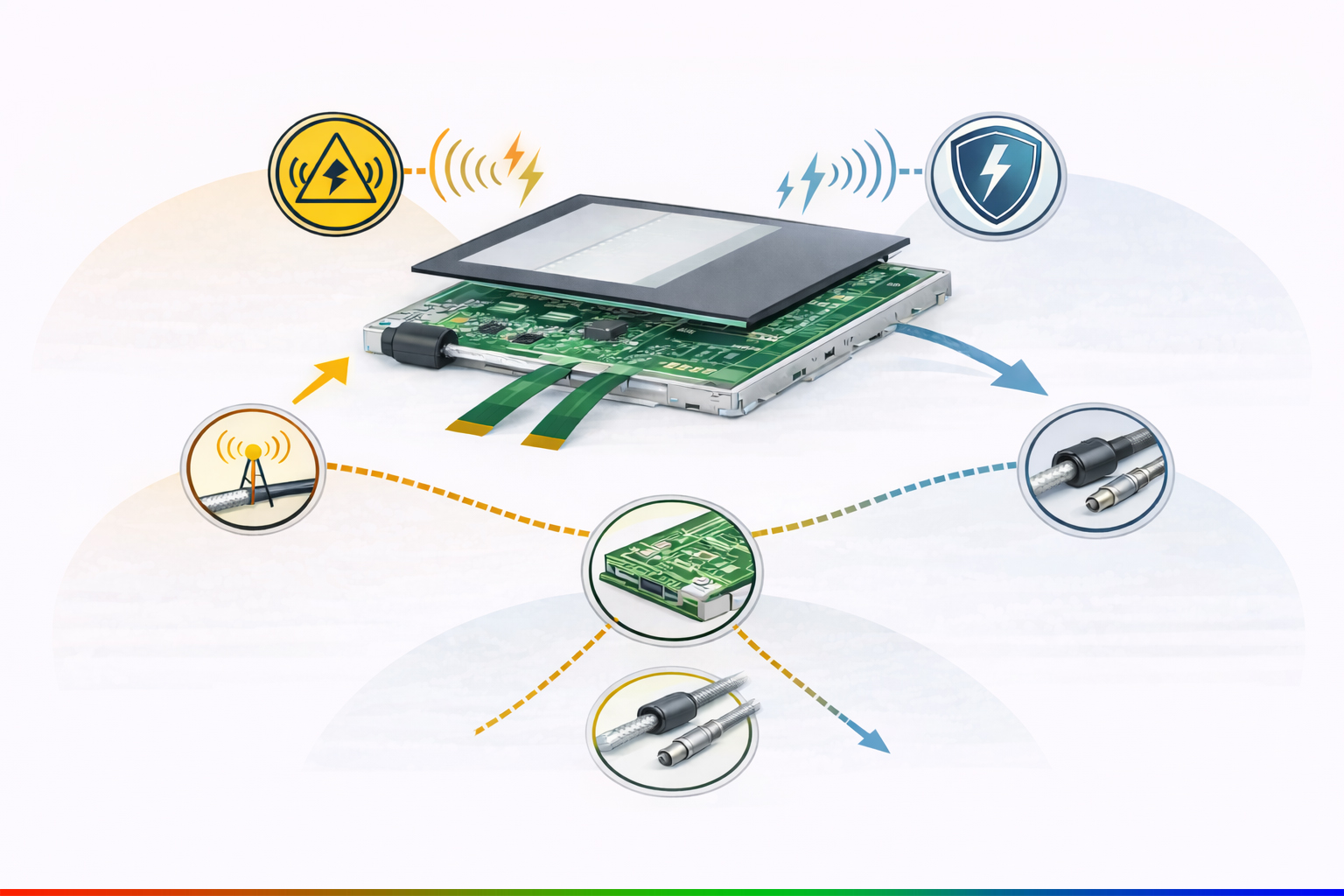
Electromagnetic compatibility (EMC) of displays is a crucial factor for the reliable operation of electronic systems – particularly in applications such as automotive engineering, medical technology, industrial electronics and aviation. Displays not only act as receivers of electromagnetic interference (EMI), but also as potential sources of interference. A lack of EMC measures can lead to malfunctions, data loss or total failure.
Typical problems
Typical EMC problems with displays:
- Interference emissions
LCD, OLED and TFT displays, particularly those with a CTP, generate high-frequency signals via signal lines or the touch controller. - Immunity
Displays are sensitive to interference from the environment, e.g. RF sources, power supplies, mobile communications or other electronic components. - Coupling
Interference can easily be coupled in or radiated via cables or inadequately shielded enclosures.
Influencing factors
Several factors can affect EMC performance:
- PCB layout
Poor grounding, long signal lines or missing impedance matching - Cables and connectors
Unshielded or poorly assembled cables can act as antennas - Touch technology
Capacitive touch sensors require sensitive analog front-ends and are therefore particularly susceptible to electromagnetic interference. Careful design of the sensor, guard, and ground lines contributes significantly to improving immunity to interference and signal quality.
Optimisation measures
Several measures can be taken to optimise EMC:
- Shielding
The use of shielded cables, ferrites, conductive foils, or metal enclosures can help effectively reduce electromagnetic interference and improve the system’s EMC performance. - Filtering
RC/LC filters, ESD protection components and EMC protection diodes at inputs and outputs - Layout optimisation
Shorter signal paths, continuous ground planes and differential signal routing
Introduction
Electromagnetic compatibility (EMC) of displays is a crucial factor for the reliable operation of electronic systems – particularly in applications such as automotive engineering, medical technology, industrial electronics and aviation. Displays not only act as receivers of electromagnetic interference (EMI), but also as potential sources of interference. A lack of EMC measures can lead to malfunctions, data loss or total failure.
Typical problems
Typical EMC problems with displays:
- Interference emissions
LCD, OLED and TFT displays, particularly those with a CTP, generate high-frequency signals via signal lines or the touch controller. - Immunity
Displays are sensitive to interference from the environment, e.g. RF sources, power supplies, mobile communications or other electronic components. - Coupling
Interference can easily be coupled in or radiated via cables or inadequately shielded enclosures.
Influencing factors
Several factors can affect EMC performance:
- PCB layout
Poor grounding, long signal lines or missing impedance matching - Cables and connectors
Unshielded or poorly assembled cables can act as antennas - Touch technology
Capacitive touch sensors require sensitive analog front-ends and are therefore particularly susceptible to electromagnetic interference. Careful design of the sensor, guard, and ground lines contributes significantly to improving immunity to interference and signal quality.
Optimisation measures
Several measures can be taken to optimise EMC:
- Shielding
The use of shielded cables, ferrites, conductive foils, or metal enclosures can help effectively reduce electromagnetic interference and improve the system’s EMC performance. - Filtering
RC/LC filters, ESD protection components and EMC protection diodes at inputs and outputs - Layout optimisation
Shorter signal paths, continuous ground planes and differential signal routing