From the first idea to series production –
your MCU / MPU comparison – smart display platforms
Overview of the platforms we currently use for our smart display solutions, with a focus on platform class (MCU/MPU), costs, software development, display protocols, maximum resolution and boot time. Resolution and cost figures are practical reference values and may vary depending on configuration, framebuffer RAM and display panel. Detailed technical information on each platform follow in the sections below.
Platform Details
Selecting the right platform for a smart display involves many variables: resolution and touch performance, response time, wireless connectivity and interface requirements, unit costs and long-term availability, all need to be considered together. We have hands-on experience with each of the following platforms, including display and touch drivers, bootloaders, OTA updates and UI stacks such as LVGL, TouchGFX, Qt or Chromium. You define the requirements of your application. We deliver complete hardware and software solutions.
| Plattform | Class | SW-Development | Display-Protocols | Max. Resolution | Boot Time |
|---|---|---|---|---|---|
| ESP32-P4 | MCU | FreeRTOS / Baremetal, LVGL | MIPI-DSI, parallel RGB | up to 1080p | < 1 s |
| STM32H7xx | MCU | RTOS / Baremetal, TouchGFX, LVGL | parallel RGB, MIPI-DSI | up to 1080p | < 1 s |
| STM32U5xx | MCU | RTOS / Baremetal, TouchGFX, LVGL | parallel RGB, MIPI-DSI | up to 720×1280 | < 1 s |
| RPi CM5 | MPU | Linux | MIPI-DSI, HDMI | 2× 4Kp60 | several seconds |
| Radxa CM3J | MPU | Linux / Android | MIPI-DSI, LVDS, HDMI | up to 4K | several seconds |
| Toradex Verdin iMX8M Plus | MPU | Linux / Android | MIPI-DSI, LVDS, HDMI | up to 4Kp30 | several seconds |
The more powerful successor to the ESP32-S3 – RISC-V dual-core with higher clock speed, MIPI-DSI display interface and hardware acceleration for 2D graphics, JPEG and H.264. This allows the ESP32-P4 to cover HMI applications that would otherwise typically require a Linux-based MPU, without making the step into the MPU world.
Strengths
MIPI-DSI up to 1080p directly from the chip, without an external display bridge
Pixel processing accelerator and video decoder reduce CPU load for animations and video playback
Up to 32 MB PSRAM supports large framebuffers and multi-layer UIs (LVGL)
Boot time < 1 s, making the smart display ready for use almost instantly without the need for a splash-screen
Class | MCU |
|---|---|
| CPU / Clock | 2× RISC-V, 400 MHz (+LP 40 MHz) |
| Internal RAM (Framebuffer) | MIPI-DSI (2-lane), parallel RGB (+ various industrial interfaces) |
| Display Interfaces | MIPI-DSI (2-lane), parallel RGB (+ various industial interfaces) |
| Maximum Resolution | Typ. 1024×600 / 800×1280 (up to 1080p) |
| Graphics Acceleration | PPA (2D), JPEG, H.264 encoder |
| Software Model | FreeRTOS / bare-metal (ESP-IDF), LVGL |
| Boot Time | < 1 s |
| Connectivity | No wireless; USB |
| Typical Application | Advanced MCU-based HMI, multimedia smart display |
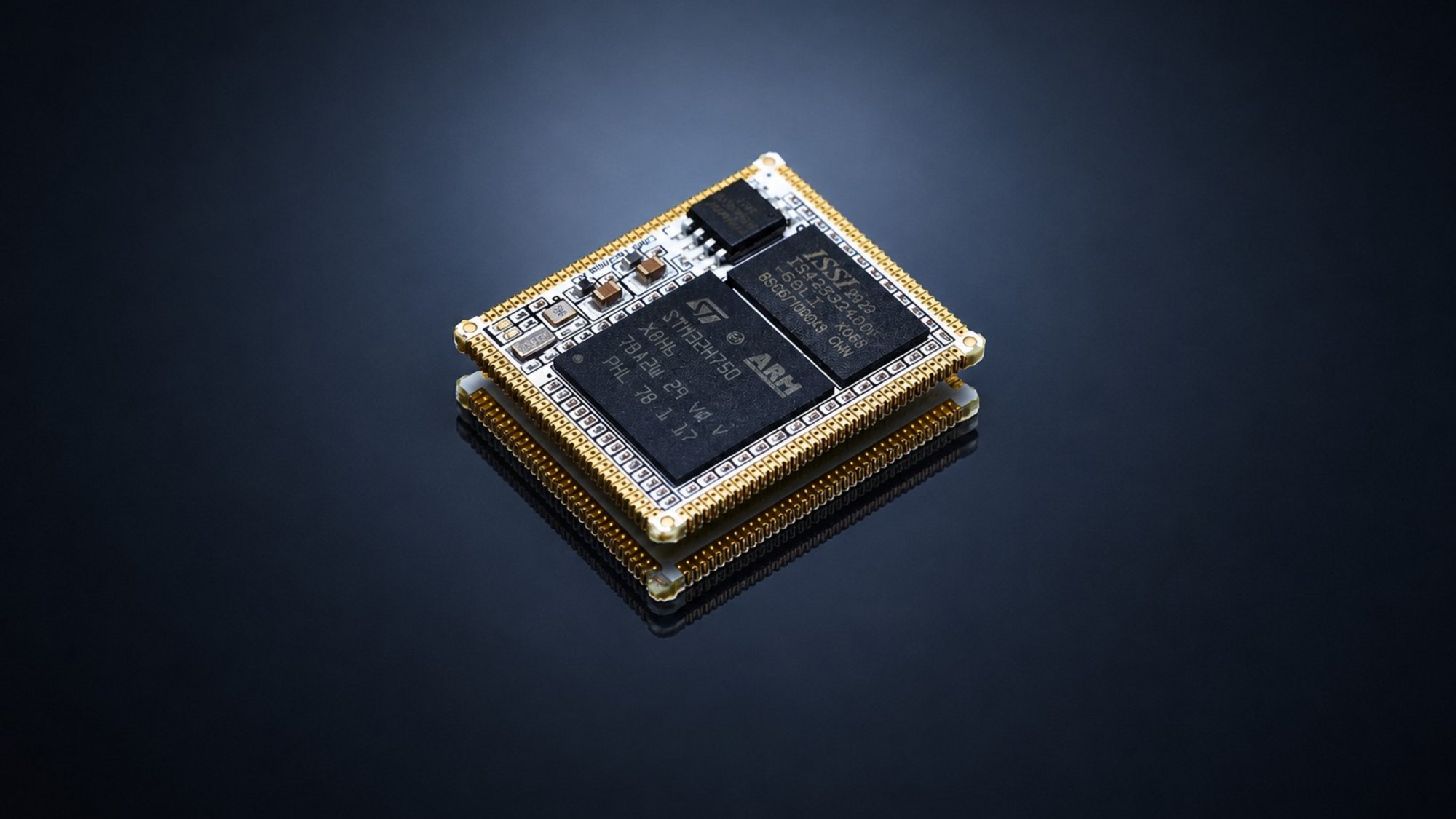
A proven Cortex-M7 platform from STMicroelectronics, combining very high clock speed, industrial-standard peripherals and the long-established STM32 ecosystem. Traditionally a strong choice for demanding, TouchGFX-based premium HMIs in industrial and medical devices where real-time performance, certifiability and a predictable product roadmap are key.
Strengths
Cortex-M7 with clock speeds of up to 600 MHz and deterministic real-time performance, without Linux scheduler jitter
TouchGFX as an integral part of the STM32 ecosystem, providing development tools, demos and PC simulator
Industrial peripherals on board: Ethernet MAC, CAN-FD, multiple SPI/I²C, ADC classes for measurement applications
ST guarantees long-term availability, an important advantage for medical and industrial designs with extended product lifecycle
H7R variant with NeoChrom GPU enables modern, animated UIs without MPU power consumption
Class | MCU |
|---|---|
| CPU / Clock | Cortex-M7, up to 480–600 MHz |
| Internal RAM (Framebuffer) | Approx. 128 KB–1.4 MB SRAM (with external RAM interface) |
| Display Interfaces | Parallel RGB, MIPI-DSI (selected types, 2-lane) (+ various industrial interfaces) |
| Maximum Resolution | Typ. 1280×800 (up to 1080p) |
| Graphics Acceleration | Chrom-ART (DMA2D); NeoChrom GPU on H7R7 |
| Software Model | RTOS / bare-metal (TouchGFX, LVGL) |
| Boot Time | < 1 s |
| Connectivity | Ethernet MAC (external PHY); no wireless |
| Typical Application | Advanced MCU HMI, multimedia smart display, TouchGFX |
The ultra-low-power variant of the STM32 family, based on Cortex-M33. When battery-powered or energy-harvesting operation is essential while a modern display is still required, the U5 is a natural choice. High-end variants such as the U5F9 and U5G9 additionally offer MIPI-DSI and a 2D GPU for animated UIs.
Strengths
Ultra-low power consumption by design, optimized for applications where long battery life is a key requirement.
Cortex-M33 with TrustZone and ST security features – basis for connected and certification-bound devices
High-end variants (U5F9/U5G9) with MIPI-DSI and NeoChrom GPU for smooth, visually appealing animations
TouchGFX and long-term STM32 roadmap, with the same toolchain as the H7 family, enabling easy switching depending on energy budget
Class | MCU |
|---|---|
| CPU / Clock | Cortex-M33, 160 MHz (ULP) |
| Internal RAM (Framebuffer) | Up to 2.5–3 MB SRAM (with ext. RAM interface) |
| Display Interfaces | Parallel RGB + MIPI-DSI (2-lane) – high-end U5F9/U5G9 only (+ various industrial interfaces) |
| Maximum Resolution | ~480×480 / 800×480 / 720×1280 |
| Graphics Acceleration | NeoChrom GPU2D + Chrom-ART (high-end) |
| Software Model | RTOS / bare-metal (TouchGFX, LVGL) |
| Boot Time | < 1 s |
| Connectivity | No wireless; USB |
| Typical Application | Battery-powered / ultra-low-power HMI, wearables |
The next generation of the CM4, featuring a Cortex-A76 processor running at 2.4 GHz and a VideoCore VII GPU, delivers significantly higher processing and graphics performance as well as 4Kp60 support on up to two HDMI outputs. When the CM4 reaches its performance limits or high-resolution multi-display applications are required, the CM5 is the logical next step.
Strengths
Significant performance upgrade over the CM4 – even complex web apps and 3D UIs run smoothly
2× HDMI 2.0 with simultaneous 4Kp60 output plus 2× 4-lane MIPI ports supporting DSI/CSI-2, providing extensive flexibility for multi-display configurations
Same compact 55 × 40 mm compute module form factor, making it suitable for embedded and custom carrier-board designs
Up to 16 GB LPDDR4 SDRAM, providing ample headroom for sophisticated Linux applications
Same toolchain and distribution maintenance as the CM4 – no platform change on the software side
Class | MCU |
|---|---|
| CPU / Clock | 4× Cortex-A76, 2.4 GHz (BCM2712) |
| Internal RAM (Framebuffer) | 2–16 GB LPDDR4X |
| Display Interfaces | 2× MIPI-DSI, 2× HDMI (4Kp60) (+ various industrial interfaces) |
| Maximum Resolution | 2× 4Kp60 |
| Graphics Acceleration | VideoCore VII GPU |
| Software Model | Linux |
| Boot Time | Several seconds (can be optimized) |
| Connectivity | GbE; WiFi/BT (variant) |
| Typical Application | High-end GUI, multimedia, browser-based HMI |
A pin-compatible industrial alternative to the Raspberry Pi CM4, based on the Rockchip RK3568J, with the "J" indicating the industrial-grade version. It integrates an NPU delivering around 0.8 TOPS for edge AI and is designed for long-term availability, making it a pragmatic option when the CM4 does not provide sufficient capabilities or when supply-chain risk needs to be mitigated.
Strengths
Industrial-grade variant with an extended temperature range and long-term availability
Integrated NPU (~0.8 TOPS) for vision and ML inference directly on the display, without additional hardware
LVDS, MIPI-DSI and HDMI available in parallel, providing flexibility for connecting different industrial display panels
Linux and Android support, offering flexibility depending on the UI strategy and operating concept
Existing Raspberry Pi CM4 carrier-board designs can be reused with moderate adaptations, helping reduce dependency on CM4 availability
Class | MCU |
|---|---|
| CPU / Clock | 4× Cortex-A55, 2.0 GHz (RK3568J, industrial grade) |
| Internal RAM (Framebuffer) | 2–8 GB LPDDR4x |
| Display Interfaces | 2× MIPI-DSI, LVDS, HDMI (+ various industrial interfaces) |
| Maximum Resolution | Up to 4K |
| Graphics Acceleration | Mali-G52 GPU + NPU (~0.8 TOPS) |
| Software Model | Linux / Android |
| Boot Time | Several seconds (can be optimized) |
| Connectivity | GbE; WiFi 5 + Bluetooth 5.0 |
| Typical Application | Open source, industrial HMI (long-term availability), edge AI |
Industrial System-on-Module from Toradex based on the NXP i.MX8M Plus, combining a Cortex-A53 processor cluster with a dedicated Cortex-M7, a 2.3 TOPS NPU and the long-life support typically required in medical and industrial fields. When a smart display becomes part of a certified product with a lifecycle of 10+ years, Toradex is an established platform provider.
Strengths
Long-term availability from Toradex and NXP, providing security well beyond 10 years and making the platform suitable for medical and industrial products
2.3 TOPS NPU – productive vision and AI tasks directly on the device, without cloud connection
Additional Cortex-M7 integrated into the SoC, allowing real-time tasks to be separated from the Linux system
Torizon platform with a container-based update and maintenance workflow, simplifying software maintenance throughout the product lifecycle
Certified carrier boards and customer references in medical and industrial applications available
Class | MCU |
|---|---|
| CPU / Clock | 4× Cortex-A53 ~1.6 GHz + M7 800 MHz (i.MX8M Plus) |
| Internal RAM (Framebuffer) | 1–8 GB LPDDR4 |
| Display Interfaces | MIPI-DSI, 2× LVDS, HDMI (+ various industrial interfaces) |
| Maximum Resolution | Up to 4Kp30 |
| Graphics Acceleration | GC7000UL GPU + 2.3 TOPS NPU |
| Software Model | Linux (Torizon/Yocto), Android (partner) |
| Boot Time | Several seconds (can be optimized) |
| Connectivity | GbE; WiFi/BT (module-dependent) |
| Typical Application | Industrial HMIs, medical HMIs, vision/AI applications, long-life products |